The Label Stays Blank: Why Collectors Are Paying More for Art That Won't Introduce Itself

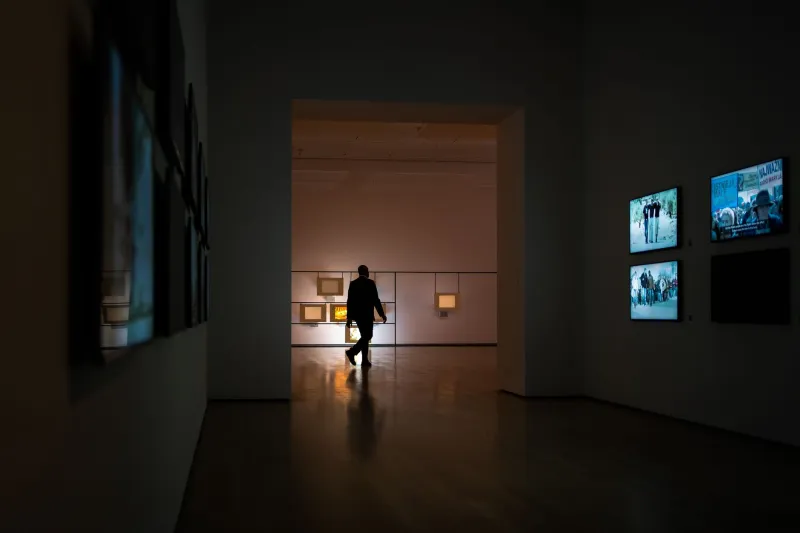
Photo: Anastasia Turkova, CC BY-SA 4.0, via Wikimedia Commons
In a collector's hard drive, the file is called 2026_11_03_loop_04.mp4. There is no title card, no caption, no artist statement. For most of the internet's history, that would read as incomplete. In 2026, it reads as deliberate.
A small but growing group of minimalist digital artists is releasing work with no name at all. Not 'Untitled' as a coy gesture, not a numbered series, just the file, the date, and maybe a wallet address. The move is showing up in drops, gallery shows, and secondary-market listings, and it is forcing collectors, curators, and even auction houses to rethink what a label is for.
The file comes first
When a Chicago collector bought a looping gradient piece this fall, the transaction came with a file, a certificate of authenticity, and a timestamp. No title. No story. The artist's site listed the work simply as '2026.11'. The collector, who asked not to be named because the purchase was private, said the absence felt less like a gap than like an invitation.
'You stop reading the wall text and start looking at the thing,' she said. 'It sounds corny, but it felt like the artist trusted me to meet the work halfway.'
That trust is the emotional core of the trend. Titles do a lot of work. They frame a piece, tell you where to look, sometimes tell you what to feel. Remove the title and the viewer has to supply the frame. For collectors who are used to being told what they own, that can be uncomfortable. For others, it is the point.
Cataloging without a name
The practical problem is obvious. How do you catalog a file that refuses to introduce itself?
Collectors are getting creative. Some use file hashes and blockchain provenance as the primary identifier. Others keep private nicknames for internal use but never publish them. Insurance and appraisal paperwork often relies on descriptive placeholders: 'a twelve-second looping gradient, 2026, single-channel digital video, edition of one.' It is not poetry, but it works.
Auction houses have adapted faster than you might expect. A listing might read 'a silent, single-color animation, duration variable' and leave it at that. The absence of a title becomes part of the lot description rather than a missing field. In a market where every asset is searchable, a nameless work is harder to index, harder to compare, and harder to summarize. That friction can read as scarcity.
Galleries, meanwhile, are experimenting with labels that give technical information and nothing else. Medium, dimensions, year, duration. No curatorial paragraph. One New York gallery director said the blank label has become a quiet flex. 'It says the work can hold the room without a caption,' she said. 'Not every piece can.'
Why silence reads as intimacy
There is a psychological reason this works. A title is a kind of instruction. It narrows the possible meanings of a piece. Without one, the viewer's own associations rush in. That can make the work feel more personal, even more private, as if you are the first person to see it rather than the latest stop in a marketing funnel.
But the trend also raises real questions. Accessibility advocates point out that a title is not the same as alt text. A work can have no poetic name and still include a clear description for screen readers. The artists doing this well separate the two: no title, but a plain-language description of what the piece looks like and how it moves. The ones doing it poorly use silence as a shield against explanation.
There is also the matter of attribution. A nameless file can travel. It can be screenshotted, re-uploaded, stripped of context. Collectors say provenance technology helps, but provenance is not the same as recognition. A title is a handle. Without one, the work relies on the artist's platform, the collector's records, and the small circle of people who already know.
The value question
Does namelessness actually raise prices? The honest answer is: not yet, not across the board. But it changes how buyers talk about value. A titled work can be compared to other works by the same artist. A nameless work is harder to slot into a series, which can make it feel singular. In a market that runs on narrative, 'no narrative' is its own narrative.
Several collectors I spoke with said they paid a premium for the silence, though none would put a number on it. One compared it to buying a piece of music with no track listing. You have to listen differently. Another said the lack of a title made the work feel less like content and more like an object.
That distinction matters in digital art, where everything threatens to become content. A title, a caption, a statement — these are the raw material of the feed. Remove them and the work resists the scroll. It becomes something you have to sit with, or ignore entirely. There is no middle ground.
The blank label as a statement
None of this means titles are dead. Plenty of minimalist digital artists still name their work, and plenty of collectors still want the story. But the blank label is no longer an outlier. It is a choice, and like most choices in this corner of the art world, it is about editing.
The artists doing it best are not being mysterious for the sake of it. They are refusing to over-explain. They are letting the file be the file. In a culture that demands a caption for everything, that restraint can feel like a gift — or a test. Either way, the market is starting to pay attention.