One Person, No Interviews, Millions of Followers: The Rise of the Invisible Digital Artist
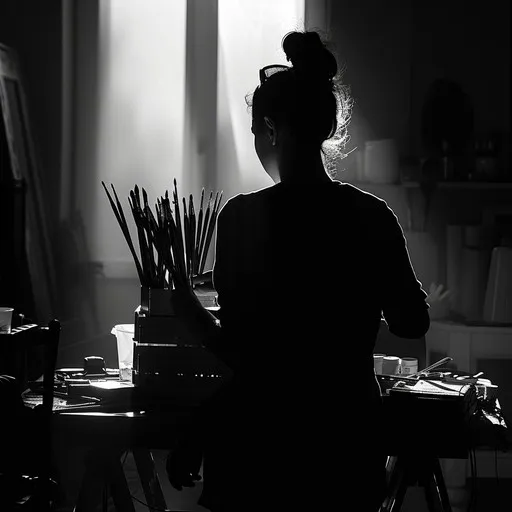
Photo: solitary artist dark minimal studio shadow silhouette creative, via images.stockcake.com
You don't know their face. You don't know their city. They've never appeared on a panel, guested on a podcast, or done a collab drop with anyone. Their bio is either blank or contains exactly one sentence that tells you nothing useful.
And somehow, their work has tens of thousands — sometimes hundreds of thousands — of people who would describe themselves as genuine fans. Not followers. Fans. The kind who check back obsessively, who track down every post, who feel something close to personal investment in someone they've never encountered as a person.
This is the invisible creator. And they might be running the smartest long game in digital art right now.
The Collaboration Industrial Complex
For most of the past decade, the conventional wisdom in digital creative spaces has been relentlessly communal. Build relationships. Do collabs. Go live. Show your face. Let people into your process. The logic was straightforward: audiences connect with people, not work. Personality was the product.
That logic produced a massive wave of creator-brand hybrids — artists whose personal identity became inseparable from their output, whose audiences were as interested in them as in anything they made. It worked for a lot of people. It also created a particular kind of exhaustion.
"There's a version of being a digital artist where you're basically a content creator who also makes art," says one observer who runs a small newsletter covering digital art markets. "The art becomes almost secondary to the persona. And for some people, that's fine. But it's not the only model."
The invisible artists are the other model. And they're thriving.
What Isolation Actually Produces
There's a practical argument for working alone that has nothing to do with mystique or brand strategy. Singular vision is, creatively speaking, a real thing.
Collaboration introduces compromise. It introduces timelines, communication overhead, aesthetic negotiation. For a certain kind of highly specific creative practice — the kind where every detail is an expression of a very particular internal logic — other people are friction.
The anonymous digital artist known only as @voidpaper (not their real handle, but the kind of handle) has been posting intricate, monochromatic generative pieces for four years without ever revealing anything about themselves. No face, no location, no backstory. Their work is immediately recognizable — a specific visual language that couldn't have been produced by committee.
"That kind of consistency is only possible when it's one brain," says digital art collector Simone Park, based in New York. "I can tell when something was made by a committee, even if I can't say exactly why. There's a quality to solo work that reads differently. More coherent, somehow. More committed."
The Mystery Premium
Beyond the creative argument, there's something happening with audience psychology that the invisible creator model exploits brilliantly, if sometimes accidentally.
Humans are pattern-completion machines. Give us a partial picture and we fill in the rest. Give us nothing about a person and we construct an entire narrative. That construction — that imagined creator — becomes deeply personal. It's ours. We built it.
When an artist reveals themselves fully — their apartment, their opinions, their daily routine — they replace your construction with their reality. Sometimes that's enriching. Often, it's deflating. The imagined version was more interesting.
Invisible creators never give you the chance to be disappointed by the person behind the work. The work is all there is. And so the work carries everything — all the projection, all the meaning-making, all the parasocial investment that would otherwise attach to a personality.
"I think people underestimate how much of fan culture is actually the fan's own imagination," says the newsletter writer. "The artist who stays invisible is basically giving their audience unlimited room to project. That's incredibly powerful."
The Cult Formation Dynamic
What's striking about the audiences that form around invisible creators is their intensity. These aren't casual followers who liked a post and moved on. They're people who have conversations about the work, who theorize about the creator's identity and intentions, who feel genuine community with other fans — all organized around someone they've never seen.
It's a dynamic that looks a lot like the cult followings that formed around anonymous musicians — Burial being the obvious touchstone, a producer who made some of the most emotionally affecting electronic music of the 2000s while refusing almost all public presence for years. The music became mythology partly because the person didn't.
Digital visual art is following the same script. The absence of the creator creates space for the audience to inhabit. And audiences, it turns out, love having room.
Is It Sustainable?
The honest complication here is that invisibility has limits. Platforms change. Algorithms punish accounts that don't do certain things — going live, posting Stories, engaging in the comment section. The infrastructure of social media is built around the assumption that creators are people who want to be known.
Invisible artists navigate this in different ways. Some have simply accepted lower algorithmic reach in exchange for creative integrity. Others have found platforms — certain corners of Tumblr, niche Discord servers, dedicated collector platforms — where the rules are different.
And a few have managed the paradox of becoming famous precisely for being unknown — where the mystery itself becomes the story that spreads.
"The less they say, the more people talk about them," Simone notes. "At a certain point, the silence is louder than anything they could actually say."
There's something very Opeal about that — the idea that restraint, that the deliberate withholding of the self, can create more presence than any amount of strategic visibility. In a digital landscape that rewards oversharing and punishes ambiguity, the invisible artist is playing a completely different game.
And right now, quietly, they're winning it.