Beautiful Broken: The Collectors Paying Top Dollar for Digital Art That Doesn't Work
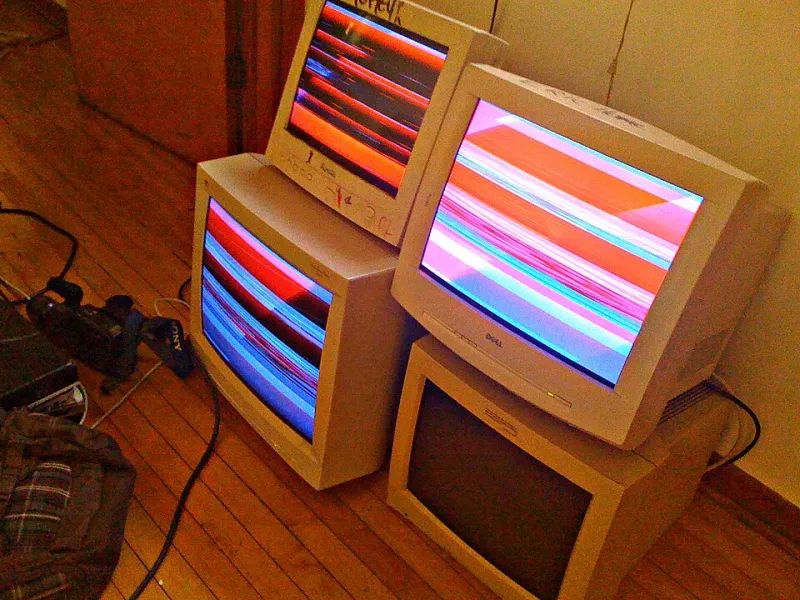
Photo: jonCates, CC BY-SA 4.0, via Wikimedia Commons
The file won't load. The image is half-rendered, pixels scattered like static across a dark field. Color bleeds where it shouldn't. The whole thing looks like something went wrong.
It did. That's the art.
Glitch art — work that embraces, weaponizes, or outright fabricates digital malfunction — has existed in underground creative communities for decades. But something has shifted recently. What was once a niche aesthetic appreciated mostly by coders and noise musicians has crossed into serious collector territory. People are paying real money — sometimes very real money — for digital pieces that appear, by every conventional standard, to be broken.
From Error to Aesthetic
The origin story of glitch art is basically the history of every creative movement: someone encountered an accident and recognized it as something more.
In the early digital era, technical failures were purely problems. Corrupted files, rendering errors, codec malfunctions — these were things you fixed or discarded. But a small community of artists, many of them coming from experimental music and early net art scenes, started noticing that errors had a visual language of their own. One that felt raw, honest, and weirdly alive in a way that polished digital work often didn't.
"There's something deeply human about a glitch," says Rosa Delgado, a Los Angeles-based artist who's been working in the space for over a decade. "It shows the seams. It shows that the machine isn't magic — it's just a very fast thing that can fail. I find that beautiful."
Rosa's recent series — partially rendered 3D figures that seem to dissolve into geometric noise — sold out through a private collector platform within 48 hours of listing. Prices started at $800 per piece.
The Authenticity Question
Here's where it gets philosophically interesting, and a little contentious: how much of this work is actually "glitched," and how much is just designed to look that way?
The answer, depending on who you ask, is anywhere from "all of it" to "none of it matters."
Some artists in this space work with genuinely corrupted data — running files through processes designed to introduce errors, bending software into behaviors it was never meant to exhibit. Others use purpose-built tools to simulate the aesthetic of malfunction without any actual technical failure involved. And a growing number occupy a middle ground, starting with real errors and then refining them, curating the chaos.
"I think the authenticity debate is kind of a dead end," says collector and digital art advisor Nathan Pryce, who's based in Chicago and has been building a glitch collection for the past three years. "When you look at a painting, you don't ask whether the brushstroke was accidental or intentional. You ask whether it works. Same principle."
Not everyone agrees. There's a vocal contingent within the glitch community that considers simulated errors a form of aesthetic fraud — a tourist's version of a practice built on genuine technical risk and experimentation.
The Underground Market Goes Above Ground
What's changed most dramatically in the past few years is where this work is being sold and who's buying it.
Glitch art has traditionally lived on platforms like Tumblr, itch.io, and various Discord servers — spaces that prioritized community over commerce. The rise of NFT infrastructure, whatever you think of it, created a mechanism for attaching scarcity and ownership to digital files. And glitch artists, perhaps more than any other digital art community, were positioned to benefit.
The idea of a file that's inherently unreproducible — a render that failed in a specific, unrepeatable way — maps perfectly onto the collector's desire for uniqueness. You can't make another one. The error was a one-time event.
But the market has also expanded beyond blockchain platforms. Private sales, direct-to-collector arrangements, and gallery representation (yes, actual physical galleries showing digital glitch work on screens) have all become legitimate pathways. The work is finding walls.
What Collectors Are Actually Buying
Spend any time talking to people who collect in this space and a consistent theme emerges: they're not buying dysfunction. They're buying evidence of a specific kind of honesty.
"Most digital art is trying to be perfect," Nathan explains. "It's trying to hide all the machinery. Glitch work shows you the machinery. It shows you the limits of the system. I find that more interesting than something that pretends those limits don't exist."
There's also something happening around the intersection of glitch aesthetics and minimalism that feels particularly relevant right now. A half-rendered image — an object that exists in a state of incompletion — carries a kind of visual restraint that over-produced work can't replicate. The absence of information becomes information.
Rosa frames it this way: "A glitch is basically the computer admitting it doesn't know what comes next. That's a kind of minimalism, right? The absence of the finished thing."
The Line Nobody Can Quite Draw
What makes this market genuinely fascinating — and genuinely complicated — is that the line between intentional art and actual malfunction is functionally impossible to locate from the outside.
A file that won't fully render could be a sophisticated artistic statement or a corrupted download. An image with pixel artifacts could be a curated aesthetic choice or evidence of a hardware problem. The visual language of failure and the visual language of glitch art are, by design, the same language.
For buyers, that ambiguity is part of the appeal. For critics, it's the whole problem.
But the market keeps moving. The files keep not loading. And the collectors keep paying for the privilege of owning something that looks, to everyone else, like something went terribly wrong.