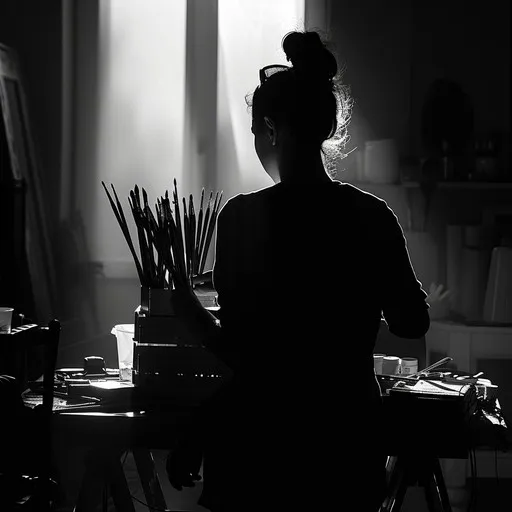
The $50,000 Setup Behind the Simplest-Looking Art on the Internet

Photo: Fuzheado, CC BY-SA 4.0, via Wikimedia Commons
It Looks Effortless. It Isn't Cheap.
Scroll through the most-admired corners of digital art right now and a pattern emerges. Clean lines. Deliberate emptiness. A single object suspended in negative space. The kind of work that makes you think: I could probably do that.
You probably couldn't. Not because the concept is complicated — it often isn't — but because producing that specific quality of simplicity requires equipment, software, and infrastructure that most people don't have access to and can't easily afford.
Minimalist digital art has a dirty secret, and it's sitting on a $4,000 monitor.
The Hardware Gap Nobody Talks About
Danielle Cho creates abstract digital compositions that typically feature two or three elements, a restrained color palette, and a lot of deliberately empty space. Her work has been licensed by tech companies, used in editorial spreads, and sold as limited prints. At first glance, it looks like the kind of thing you might make in a free browser app on a slow afternoon.
Her actual setup: a Mac Pro tower, a reference-grade display calibrated to professional color standards, a Wacom tablet that costs more than most people's monthly rent, and a suite of software subscriptions that run her close to $700 a year. She estimates her total equipment investment at somewhere north of $45,000, accumulated over a decade.
"People see the output and they think it's accessible," she says. "The aesthetic is minimal. The path to the aesthetic is not."
This is the paradox sitting at the center of the minimalist digital art movement. The less there is in the work, the more precisely every element has to function. A single line needs to be exactly right. A gradient needs to transition with a smoothness that consumer-grade hardware simply can't render at the resolution required for professional use. The margin for technical error shrinks as the visual complexity decreases.
Why Simplicity Demands More, Not Less
There's a craft logic to this that holds up under scrutiny. In a busy composition, imperfections hide. A slightly off color value, a line that's not quite crisp, a texture that reads a little muddy — all of it gets absorbed into the visual noise. Complexity is forgiving.
Minimalism is not. When there are three elements in a frame, the audience sees all three with full attention. Every technical flaw is exposed. The work has nowhere to hide.
Ryan Torres, a digital artist in Los Angeles who specializes in what he calls "reduced form" illustration — think single objects on stark white backgrounds — explains it this way: "I spend more time on a piece that has one thing in it than I do on something with twenty things. The one-thing piece has to be perfect. The twenty-thing piece can be good."
Torres runs a workstation that he's invested approximately $30,000 in over five years. He uses professional 3D rendering software, a high-end stylus display, and a color management system that he calibrates monthly. "If my colors are even slightly off, the whole piece fails. There's nothing else to look at."
The Class Dynamics of 'Less'
This is where the conversation gets uncomfortable. Minimalism — in design, in art, in lifestyle — is often coded as accessible. Less stuff, less complexity, less noise. It feels democratic, even egalitarian. The reality of producing minimalist digital art at a professional level is almost the opposite.
The barrier to entry is significant. Professional-grade displays alone can run $2,000 to $8,000. Industry-standard software requires ongoing subscription costs that add up quickly. And then there's the time investment — years of technical training to develop the precision that makes simple work look simple rather than unfinished.
"There's a version of minimalism that's actually a luxury aesthetic," says Cho. "It takes money to look like you're not trying. That's true in fashion, it's true in interior design, and it's absolutely true in digital art."
Art educator and critic Simone Adeyemi has written about this dynamic in the context of broader design culture. "When we celebrate the 'effortless' aesthetic, we're often celebrating the product of significant resources — financial, educational, technological. The effortlessness is performed. It's the whole point. But the performance costs something, and not everyone can afford the costume."
The Skill Debt Behind the Clean Finish
Beyond equipment, there's the question of expertise. The technical skills required to produce high-quality minimal digital work — precise vector construction, color theory at a professional level, understanding of negative space as an active compositional tool, mastery of rendering and output formats — take years to develop.
Torres estimates he spent four years in school and another three working in commercial design before he had the technical foundation to produce the stripped-back work he makes now. "You have to learn everything before you can take it away," he says. "The minimalism is a result of knowing too much, not knowing too little."
This matters because it shapes who gets to participate in the minimalist aesthetic conversation at a professional level. The artists whose "simple" work commands serious prices almost universally have extensive technical backgrounds. The look is minimal. The resume isn't.
Does Any of This Make the Work Less Valid?
Not necessarily. The fact that something requires significant resources to produce doesn't undermine its value as art. And there's something genuinely interesting about a visual language that conceals its own complexity — that's a kind of craft in itself.
But it does challenge the narrative that minimalism is inherently more democratic or accessible than other forms of digital art. It isn't. It's just better at hiding what it costs.
Cho puts it simply: "I love what I make. I think it's worth what people pay for it. But I try to be honest about the fact that I'm not operating from some pure, unencumbered creative space. I have the equipment, the training, and the time that this kind of work requires. Not everyone does. That's worth saying out loud."