Slow Down to Feel Something: Why Stripped-Back Digital Art Is Becoming the Internet's Antidepressant
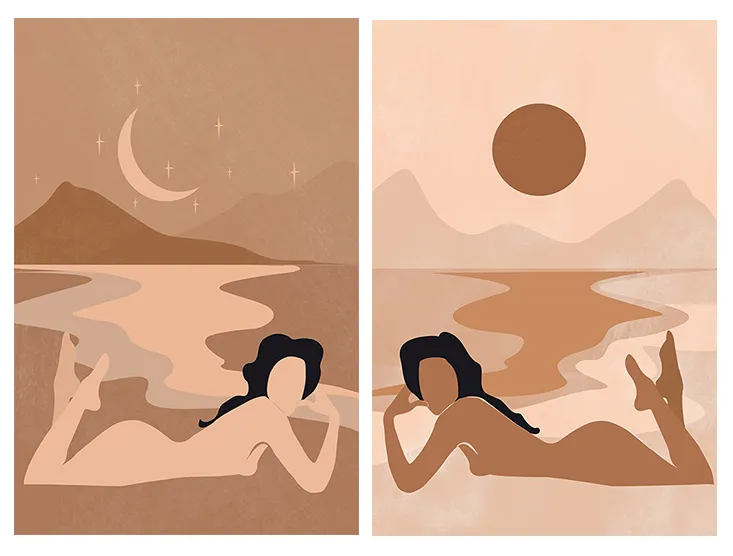
Photo: Anastasia Turkova, CC BY-SA 4.0, via Wikimedia Commons
Open your phone right now and count how many things compete for your attention in the first ten seconds. Notifications, autoplay videos, breaking news banners, red badge counts. If you're like most Americans, you're navigating somewhere between four and seven hours of screen time a day, most of it engineered by teams of behavioral scientists whose job is to keep you looking.
Now imagine a single, still image. A pale field of gray with one thin horizontal line near the center. No caption. No call to action. Just space.
For a growing number of people, that image is the most important thing they'll encounter online all week.
The Fatigue Is Real
Content oversaturation isn't a new conversation, but the scale of it keeps shifting. Platforms have spent years optimizing for engagement metrics—clicks, shares, watch time—and the result is a feed ecosystem that functions less like a window to the world and more like a slot machine calibrated to your specific neurological weaknesses.
People are noticing. A 2023 survey from the American Psychological Association found that a significant portion of US adults identified social media as a source of stress, not relief. Terms like "doom scrolling" and "digital burnout" have moved from tech-Twitter jargon into mainstream vocabulary. Therapists are reporting clients who specifically cite their online environments as a source of anxiety.
Into this context arrives a counterculture that's been quietly building for several years: minimalist digital art and intentionally slow content, made by creators who seem almost allergic to the attention economy's core assumptions.
What "Slow Content" Actually Looks Like
The range is wider than you might expect. It includes long-form ambient video—hour-long loops of subtle digital textures that shift almost imperceptibly. It includes sparse illustration accounts that post once a week, sometimes once a month, with no explanation and no hashtags. It includes generative art pieces that take twenty minutes to fully render on screen, designed to be watched rather than scrolled past.
What unites them is an intentional refusal to compete for attention through stimulation. Instead, they offer something that's become genuinely scarce: a reason to stop.
Jasmine Reyes, a UX researcher in Austin who started following minimalist art accounts during the pandemic, described her experience with specific clarity. "I'd be spiraling through Twitter and I'd hit this one account—just soft geometry, nothing else—and it was like someone turned the volume down. Not in a boring way. In a relief way."
She's not alone. The comment sections on these accounts are full of variations on the same testimony: I needed this today. This made me breathe. I didn't realize how tense I was until I looked at this.
The Creators Behind the Calm
The artists making this work often describe their motivation in therapeutic terms themselves, even when they're not trained therapists.
Dallas-based digital artist Keane Oduya started his sparse visual practice after burning out from a decade in advertising. "I spent years making things louder, more urgent, more eye-catching," he said. "When I started making work for myself, I went in the exact opposite direction. I wanted to make something that asked nothing of you."
His current project—a weekly still image, always the same dimensions, always a single color with one deliberate mark—has accumulated 200,000 followers on Instagram. He posts no Reels, runs no ads, and has never used a trending audio clip. His growth has been entirely word-of-mouth, driven by people tagging friends with messages like this is what my brain needs right now.
"I think people are hungry for permission to slow down," Keane said. "The work gives them that. It says: this is enough. Being here for a moment is enough."
Communities Built Around Breathing Room
Beyond individual creators, entire communities have formed around the anti-maximalist impulse. Subreddits dedicated to "digital minimalism" and "calm aesthetics" have memberships in the hundreds of thousands. On Discord, servers focused on ambient and sparse digital art function almost like meditation groups—members share work, discuss the philosophy behind restraint, and check in about their own screen habits.
There are also platforms specifically designed to host this kind of content without algorithmic interference. Are.na, a visual research tool popular among designers, operates on a deliberately non-addictive model with no likes, no follower counts, and no feed ranking. It's become a favorite among minimalist creators who want their work experienced on its own terms.
"Are.na feels like a library," said one illustrator who maintains both an Instagram and an Are.na presence. "Instagram is a concert. Sometimes you want the concert. But sometimes you just want to go somewhere quiet and look at things."
The Therapeutic Conversation
Some mental health professionals are paying attention. Art therapy has a long history of using visual creation and contemplation as tools for emotional regulation, and there's emerging interest in whether digital content can serve similar functions.
"There's something meaningful about an image that doesn't demand a response from you," said one licensed therapist who works with clients experiencing digital anxiety. "Most content is transactional—it wants your reaction, your share, your click. Something that just exists without asking for anything can be genuinely restorative."
This isn't a claim that looking at a minimalist art account replaces therapy. But the intuition that certain kinds of visual experience calm the nervous system isn't far-fetched. It maps onto well-documented research about attention restoration and the psychological benefits of environments low in complexity and high in coherence.
What This Means for Digital Culture
The rise of slow, spare digital content as a cultural phenomenon says something interesting about where we are as an internet society. When stillness becomes a value proposition—when asking nothing of you is a creative strategy that actually works—it suggests that the pendulum of digital culture may be reaching a limit.
Not everyone will follow it back. The attention economy isn't going anywhere. But for a significant and growing segment of American internet users, the most compelling thing a digital creator can offer isn't more stimulation. It's a moment of genuine quiet in a very loud room.